Le Infezioni in Medicina, n. 3, 359-363, 2023
doi: 10.53854/liim-3103-9
ORIGINAL ARTICLES
Response to BNT162b2 mRNA COVID-19 vaccine of ART-experienced people living with HIV: a prospective analysis from a single-center study in Rome, Italy
Francesca Lombardi1, Simone Belmonti2, Simona Di Giambendetto1,2
1Fondazione Policlinico Universitario A. Gemelli IRCCS, UOC Malattie Infettive, Roma, Italia;
2Università Cattolica del Sacro Cuore, Dipartimento di Sicurezza e Bioetica, Roma Italia
Article received 29 June 2023, accepted 31 July 2023
Corresponding author
Francesca Lombardi
Email: francesca.lombardi@gmail.com
SummaRY
Objectives: We aimed to assess the immunologic response to BNT162b2 mRNA COVID-19 vaccine in ART-experienced people living with HIV (PLWH).
Methods: In this pilot prospective study, we enrolled 20 PLWH (all on effective ART, 80% with CD4 cells count >500) and 52 immunocompetent health-care workers, as control. All subjects received two doses of vaccine 21 days apart. Serum samples were collected at different time points, immediately before first administration (BL) and 21 days after each dose (T1 and T2) and 45-50 days after second dose (T3). We evaluated the immune response in terms of frequency of responders and antibody titers against SARS-CoV-2 at each timepoint. The viro-immunological parameters of PLWH were also monitored.
Results: We found that the participants displayed an immune response after the first dose that increased markedly at T2. At T3 a significantly descending trend of IgG levels was observed in both groups. No difference in humoral immune response assessed in terms of percentage of responders after first and second dose and in terms of IgG titers over time and at each time point was found between groups. Any significant variation in terms of viremia and immunological parameters was observed in PLWH.
Conclusions: BNT162b2 mRNA COVID-19 vaccine appears immunogenic in this setting of PLWH eliciting an immune response comparable to that of healthy donors.
Keywords: HIV, COVID-19, mRNA vaccine.
INTRODUCTION
To date the immunogenicity of the BNT162b2 m-RNA COVID-19 vaccine in people living with HIV (PLWH) has been explored in very few studies and has not yet been fully characterized [1-3]. It is important to collect data on the immune response to the SARS-CoV-2 vaccine in PLWH because it has been demonstrated that the immune abnormalities that occur during HIV infection can affect response to the vaccines despite high-efficient antiretroviral therapy (ART) [4-6].
In fact, ART is able to maintain the virological suppression and guarantee a favorable immunological profile but not fully eliminate HIV-induced inflammation and immune activation. This suggests that some immune defects may persist despite the ART and might induce suboptimal response to the vaccines.
Although the few existing studies have generally shown good efficacy and safety, data are scanty regarding the immunogenicity of the mRNA COVID-19 vaccine in PLWH versus non HIV-infected people [1-3]. Furthemore, the interplay between the mRNA vaccine and the viro-immunological status of PLWH is still unclear.
In particular, previous studies have reported an increase of plasma HIV-RNA in patients on ART following the m-RNA SARS-CoV-2 vaccination, which might reflect the induction of a reversal proviral latency and the production of viral particles: the potiental role of vaccination is assessed for different vaccines thus far [7-9].
Aim of this study was to evaluate humoral immune response to the BNT162b2 mRNA COVID-19 vaccine in PLWH as compared to that of healthy donors. The dynamic of viro-immunological parameters of PLWH was also monitored.
PATIENTS AND METHODS
Study design and participants
This prospective, monocentric study was performed when the first Italian national vaccination program was launched (30 December 2020). At that time, access to the campaign was reserved to healthcare workers, socio-health professionals, nursing home operators, while PLWH did not yet meet the inclusion criteria. Thus, in this study, we evaluated a cohort of PLWH falling in the above mentioned scheduled categories who were able to regularly receive BNT162b2 vaccine from their own vaccination hub and were contextually under routine follow-up at Infectious Diseases Unit of our hospital “Fondazione Policlinico Universitario A. Gemelli IRCCS” in Rome, Italy. We also evaluated a group of healthy donors, who were a group of health-care workers (HCW) in our hospital and who underwent vaccination, as part of occupational health surveillance program, with the same vaccine in the same schedule/timeframe.
Written informed consent was obtained from all participants, and the study was done in accordance with the principles of the Declaration of Helsinki and Good Clinical Practice. The study protocol (286_2021) was approved by AIFA and the INMI “Lazzaro Spallanzani” Ethics Committee (Roma, Italy), responsible for the evaluation of studies assessing the efficacy of drugs against SARS-CoV-2 in the Italian territory.
PLWH and HCW enrolled received two doses of the BNT162b2 vaccine 21 days apart, as per protocol. Serum samples were collected from January 2021 to July 2021 at different timepoints, i.e., immediately before the first administration (BL) and 21 days after each dose (T1 and T2) and 45-50 days after the second dose (T3). We evaluated the immune response in terms of frequency of responders and antibody titers against SARS-CoV-2 at each timepoint. Demographical and clinical data related to HIV subjects were collected from our electronic database at each time point. Information about virological and immunological parameters were recorded at BL and at least two other timepoints a few months apart after the second dose. We defined viral rebound as any HIV-RNA determination ≥30 copies/mL that occurred during the study. Residual viraemia status (any value of plasma HIV-RNA <30 copies/mL) was categorized as either target detected (TD, <30 HIV-RNA copies/mL) or target not detected (TND, 0 HIV-RNA copy/mL). Information regarding severe adverse events (SAE) to vaccination was monitored (defined as death; life-threatening at the time of the event; inpatient hospitalization or prolongation of existing hospitalization; persistent or significant disability/incapacity; a congenital anomaly/birth defect; medically important event based on medical judgment) [10].
Antibodies quantification
The IgG antibodies against the S1 RDB subunit of the SARS-CoV-2 spike protein were quantified by an automated chemiluminescent immunoassay (COV2G, Siemens Healthineers, Erlangen, Germany). The perfomance of the assay was assessed on Atellica IM1300 analyzer (Siemens Healthineers, Erlangen, Germany) [11]. This system reports results as non-reactive, index value <1, i.e., negative for antibodies against SARS-CoV-2 antigens, or reactive, index value ≥ 1, i.e., positive for antibodies against SARS- CoV-2 antigens. Subjects who showed at BL an index <1 were considered as having never been infected by the SARS-CoV-2.
Statistical analysis
When we designed the study, no data were available regarding COVID-19 immunogenicity in PLWH . Being this study an exploratory analysis, formal sample size estimation a priori was not performed. Quantitative variables were described as medians and interquartile range (IQRs) and categorical variables were presented as frequencies and percentages. Antibodies against SARS-CoV-2 were treated both as binary variable (≥ or <1), to calculate the percentage of responders, and as continuous variable for antibody concentration. Antibody concentrations were log-transformed to approximate normal distributions and expressed as geometric mean titers (GMTs U/mL). A linear mixed model for repeated measures adjusted for the covariates that resulted different at baseline between the two groups was used to compare the log-transformed antibody concentrations over the study period within and between the two groups. Differences were considered significant at the conventional p level <0.05. Analyses were performed using the SPSS software package (version 22.0 Chicago, IL).
RESULTS
A total of 20 PLWH and 52 HCW were enrolled. All subjects from each group completed the vaccination schedule. No subject in the study showed evidence of prior SARS-CoV-2 infection based on self-reported data and negative serology at BL.
In the HCW control group, n=12 subjects were male (23.1%), median age (IQR) was 42.5 ( 32.2-53.8) years.
HIV-associated parameters in PLWH are presented in Table 1. Among PLWH, there were more males compared with the control group (p=0.011), and they were older than the controls (p =0.027).
Table 1 - Baseline characteristic of PLWH.
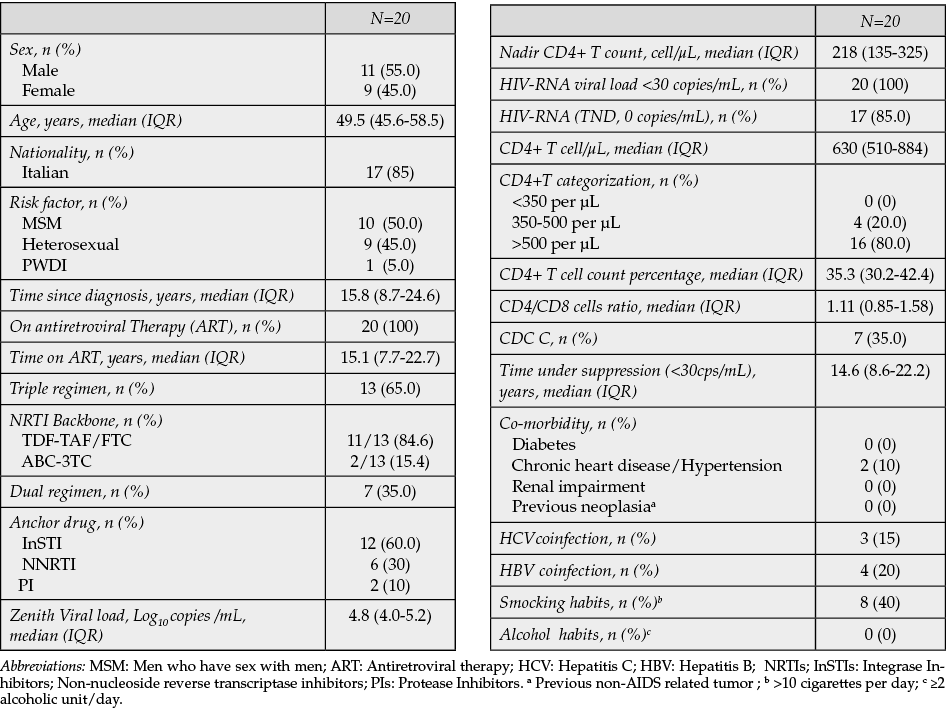
At the time of vaccination all PLWH were receiving an effective ART, most (18/20, 90%) showed TND status and 80% showed CD4>500 cell count.
Percentages of subjects from PLWH and HCW who developed a positive response after the first dose of the vaccine were comparable (85.0 vs 92.3 p=0.298). The second dose elicited a humoral response in 100% of subjects in both groups. At T3 all subjects in both groups maintained antibody titers >1.
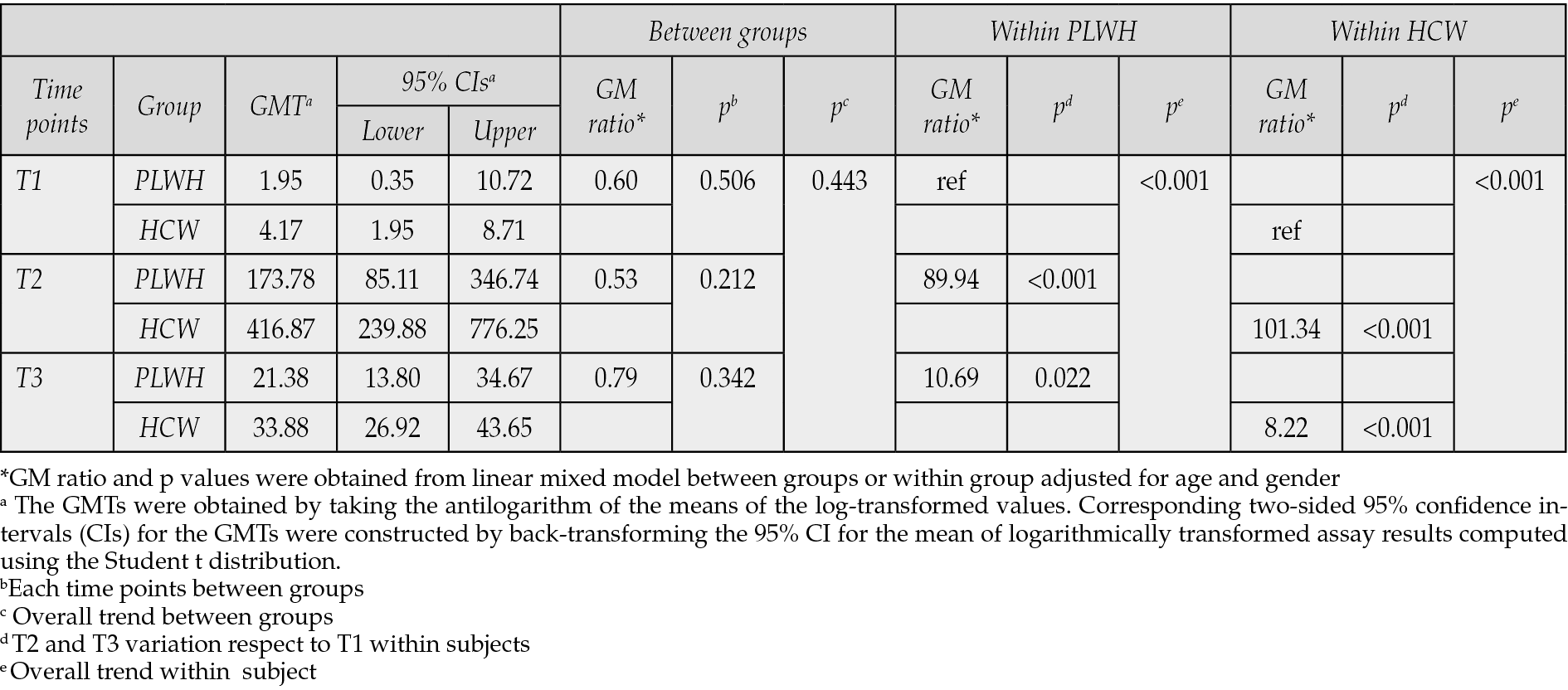
Antibody GMTs at different time points are summarized in Table 2. Both PLWH and HCW showed comparable dynamics of IgG concentrations over time (p=0.443) and at each time point (all p values ns). Considering the two groups separately, there was a significant time effect in both groups (both p<0.001); when single time points were compared (pairwise comparison) the participants displayed an immune response after the first dose (T1) that increased markedly after the second dose (T2) (both p<0.001). At T3 a significantly descending trend of IgG levels was observed in both groups with respect to T2 (both p<0.001); however, the IgGs remained at higher levels when compared to T1 in the two groups (p=0.022 and p<0.001, respectively).
Table 2 - Comparison of GMC of IgGs between and within two groups over the three time points.
Using regression analysis we found that younger age was independently correlated with percentage of responders after the first dose (OD 0.937, 95%CI 0.881-0.996, p=0.038) and that the overall GMTs response was negatively correlated with age (r=-0.215, p=0.002).
No case of virological rebound was observed in PLWH and no differences in percentage of TD/TND status occurred during the study period (p=1.000). Regarding the CD4 cell count and the CD4/CD8 ratio no significant variation was found (p=0.322 and p=0385, respectively). During follow-up, SARS-CoV-2 infections were not found in the vaccinated population. No SAEs were reported.
DISCUSSION
In previous studies it was observed that the mRNA vaccine, specifically BNT162b2, is able to induce an antibody response in PLWH [1-3]. Our data confirm and further support these findings; indeed, in our study this immune response was not significantly different from that of healthy donors. Of note, since it has been previously observed that the humoral response after vaccination or natural SARS-CoV-2 infection tends to decline in a short time, we collected samples at a time point 45-50 days after the second dose in order to better evaluate the short-term humoral response [12]. We showed that the antibodies remained significantly higher respect to the first dose, but they tended to decline when compared to the second dose; however, the trend in PLWH was comparable with that of healthy donors.
It must be considered that this superimposable data between PLWH and heathy people in our study might reflect the fact that our PLWH showed a good, stable and favourable immunological status and mostly were with undetectable viral load. Moreover, the enrolled population appears to be apparently younger than the entire population with HIV infection being treated in our Center. Therefore, our findings could be not fully extrapolated to HIV-infected patients who have a more severe immune deficiency, in whom a different scenario could be expected.
The vaccine did not affect the viro-immunological status of the PLWH in our study. In particular, following several months from the second dose the subjects did not show any significant variation in terms of viremia and CD4 cells when comparared to the baseline values. Other studies have reported cases of an increase in plasma HIV-RNA in patients on ART after the SARS-CoV-2 vaccination; here the peculiarities of the cases could be advanced HIV infection with a higher pre-ART HIV-RNA set-point (6-7 log10 cps/mL), compared to our PLWH cohort which presented a lower pre-ART HIV-RNA load of 4-5 log10 cps/mL as well as a relatevely short time interval between HIV diagnosis and beginning the first ART [9].
This is important because it could indicate that the viral burden, i.e., a larger reservoir, could have contributed to the observed increase in HIV-RNA upon stimulation observed in these cases but not in our cohort.
Thus, this aspect warrants further analyses as it could be important both for clinical practice in the context of mass vaccination and for the design of future eradication interventions based on the mRNA vaccines as agents.
The main limitation of this study is the small sample size. This was due to the fact that at that time BNT162b2 mRNA vaccine was only offered to specific categories whereas other groups at risk, including PLWH, were given different levels of priority and were not included. Thus, we could enroll only PLWH who fell into specific categories. Despite this limitation, we believe that our results add new data on the immune response to the BNT162b2 mRNA COVID-19 vaccine in PLWH and the interplay between the vaccine and viro-immunological status of PLWH that warrant further larger studies.
Acknowledgments
We would like to thank all healthcare workers and Prof Maurizio Sanguinetti, Michela Sali and Mery Pereyra Boza, from Dipartimento di Scienze di Laboratorio e Infettivologiche, Fondazione Policlinico Universitario A. Gemelli IRCCS, for their technical support.
Conflict of interest
None to declare.
Funding
None
REFERENCES
- Woldemeskel BA, Karaba AH, Garliss CC, et al. The BNT162b2 mRNA vaccine elicits robust humoral and cellular immune responses in people living with human immunodeficiency virus (HIV). Clin Infect Dis. 2021; 74 (7), 1268-1270.
- Levy I, Wieder Finesod A, Litchevsky V, et al. Immunogenicity and safety of the BNT162b2 mRNA Covid-19 vaccine in people living with HIV-1. Clin Microbiol Infect. 2021; 27 (12), 1851-1855.
- Milano E, Ricciardi A, Casciaro R, et al. Immunogenicity and safety of the BNT162b2 COVID-19 mRNA vaccine in PLWH: A monocentric study in Bari, Italy. J Med Virol. 2022; 94 (5), 2230-2236.
- Couch RB. Influenza, influenza virus vaccine, and human immunodeficiency virus infection. Clin Infect Dis. 1999; 28 (3), 548-551.
- Tebas P, Frank I, Lewis M, et al. Center for AIDS Research and Clinical Trials Unit of the University of Pennsylvania. Poor immunogenicity of the H1N1 2009 vaccine in well controlled HIV-infected individuals. AIDS. 2010; 24 (14), 2187-2192.
- Fabbiani M, Sidella L, Corbi M, et al. HIV-infected patients show impaired cellular immune response to influenza vaccination compared to healthy subjects. Vaccine. 2013; 31 (28), 2914-2918
- Brichacek B, Swindells S, Janoff EN, et al. Increased plasma human immunodefi- ciency virus type 1 burden following antigenic challenge with pneumococcal vaccine. J Infect Dis. 1996; 174 (6), 1191-1199.
- Yek C, Gianella S, Plana M,et al. Standard vaccines increase HIV-1 transcription during antiretroviral therapy. AIDS. 2016; 24: 30 (15), 2289-2298.
- Bozzi G, Lombardi A, Ludovisi S, et al. Transient increase in plasma HIV RNA after COVID-19 vaccination with mRNA-1272. Int J Infect Dis. 2021; 113, 125-126.
- Polack FP, Thomas SJ, Kitchin N, J. et al. Safety and Efficacy of the BNT162b2 mRNA Covid-19 Vaccine. N Engl J Med. 2020; 383 (27), 2603-2615.
- Florin L, Maelegheer K, Vandewal W, et al. Performance Evaluation of the Siemens SARS-CoV-2 Total Antibody and IgG Antibody Test. Lab Med. 2021;52(6), e147-e153.
- Chia WN, Zhu F, Ong SWX, et al. Dynamics of SARS-CoV-2 neutralising antibody responses and duration of immunity: a longitudinal study. Lancet Microbe. 2021; 2 (6), e240-249.